Table of Contents
Originally a cutting edge exhibit hall, the Hiroshima Prefectural Industrial Promotion Hall has morphed into one of the most famous battle-scarred remains in all of history. Today it is known as the Atomic Bomb Dome or Genbaku Dome, a relic preserved from the atomic bombing of Hiroshima on August 6, 1945. The story also merges commercial expansion, the history of war, post-war restoration and peace education.
Quick Answer
Hiroshima Prefectural Industrial Promotion Hall which was completed in 1915 for the purposes of promoting commerce, local products, research, and culture. Occupying a spot near the hypocenter of the atomic bombing in 1945, remnants of its brick walls and steel dome frame stood. It was later preserved as the Atomic Bomb Dome and declared a UNESCO World Heritage Site in 1996.
The Hiroshima Prefectural Industrial Promotion Hall is the former exhibition hall in whose surviving ruins are preserved as a Unesco World Heritage Site known informally as atomi.
Hiroshima Prefectural Industrial Promotion Hall
The Hiroshima Prefectural Industrial Promotion Hall was a European-style municipal hall located on the banks of the Motoyasu River in central Hiroshima. It showed off local products, assisted explores the commercial sphere, housed exhibitions and played a role in cultural life.
The building was designed by Czech architect Jan Letzel. It was opened as the Hiroshima Prefectural Commercial Exhibition Hall in April 1915, became HHI (Hiroshima Prefectural Products Exhibition Hall) established in 1921, and its best-known prewar name (the structure had undergone numerous modifications before that year) came as a result of renaming it again in 1933.
more remote destinations worth discovering
Key Facts at a Glance
| Fact | Verified detail |
| Completion | April 1915 |
| Architect | Jan Letzel |
| Main purpose | Trade, exhibitions, research, and culture |
| Bombing date | August 6, 1945 |
| Preservation resolution | 1966 |
| First conservation work | 1967 |
| UNESCO inscription | 1996 |
The building covered about 1,023 square meters and stood roughly 25 meters high. Its three-story wings surrounded a taller central section capped by an oval copper dome.
Abridged history: historic Exhibition Hall Atomic Bomb Dome
Stages of History for the Hiroshima Prefectural Industrial Promotion Hall as a Monument: Commercial Landmark, Wartime Office Building and Peace Memorial It’s that anything only in dereliction, like all buildings’ later life, practices a prior use—the ruin ignores its first 30 years as an ongoing civic project.
Fact #1: It Was Constructed to Bolster the Economy of Hiroshima
In 1910, a hall for promoting local products was established in Hiroshima Prefecture. This building, which opens in 1915 with offices, exhibition rooms and gardens as well as spaces for trade and design consultation.
Art and cultural events were also held in the hall. It was developed for commerce and community, not for the military.
Fact #2: It Was Architecturally Weird
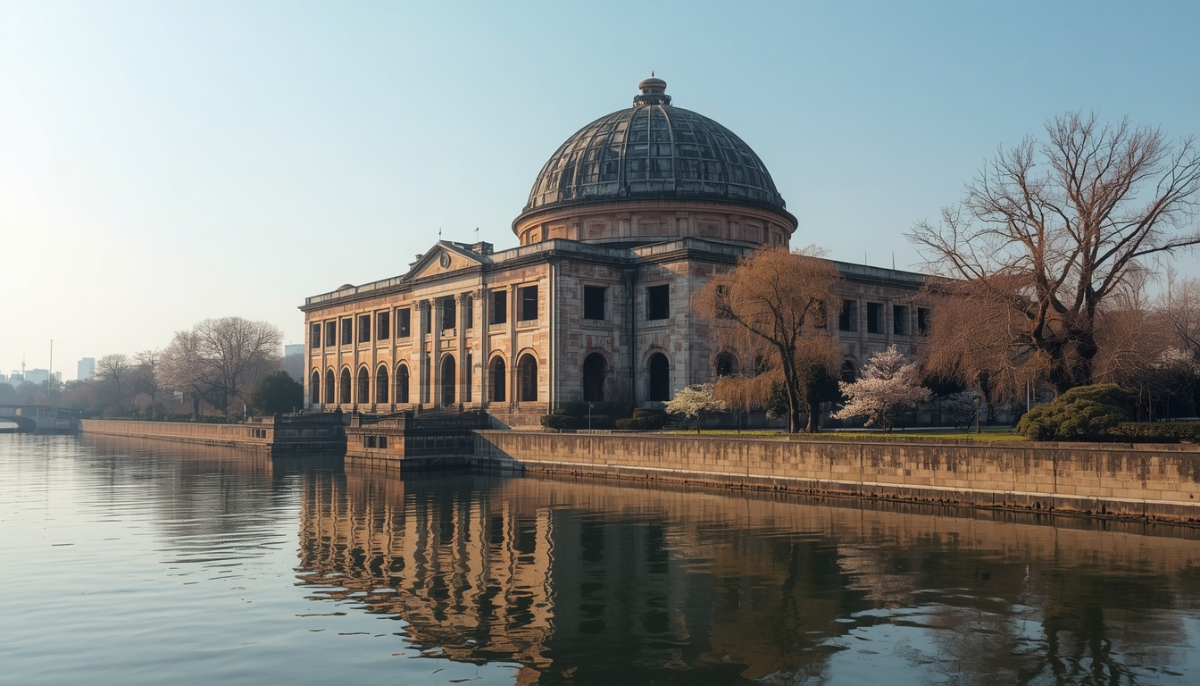
At a time when most buildings in Hiroshima were still two-story wooden structures, the Hiroshima Prefectural Industrial Promotion Hall towered over the rest of the city. The brick structure, stone-and-mortar exterior, huge windows and copper-covered dome imparted a decidedly European look.
The riverfront site housed a recognizable landmark. This left the structure with a skeletal, which inspired its name Genbaku Dome.
Classified Fact three: Usage in WWII
Exhibitions were shrinks as wartime conditions deteriorated. As of 31 March 1944 the building had been repurposed, primarily for governmental agencies and war-time control services as office space.
By 1945, it had become unrecognizable from the vibrant exhibition hub people had once known.
Hal, Interested by Hiroshima and Hal
The Hiroshima Prefectural Industrial Promotion Hall becomes significant because it makes something, which was pinned down as an irreconcilable historical event, visible evidence of its own corporeality. The craters in its walls testify to destructive force, whilst its preservation reflects a city’s wish to remember.
FACT 4: Its location was very close to the hypocenter of the blast.
At 8:15 a.m. on August 6, 1945, an atomic bomb went off in the air over Hiroshima. The blast was almost right above the hall and killed all those who were inside it. Because a large part of the pressure was from above, some parts of the vertical structure and center tower did not collapse.
The structure was no longer a complete one. The roof, floors and interior were all gone.
Fact 5: Preservation Was Controversial
Immediately post-war, residents quarrelled over the wreckage. Some people wanted to preserve the site as a memorial, while others viewed it as a danger, a source of trauma or an obstacle to redevelopment.
The site was handed over to Hiroshima City in 1953 by Hiroshima Prefecture. The City Council approved a preservation resolution on the site after years of structural deterioration, public debate and an unsuccessful sale period in July 1966 that prompted planning for its first conservation project in 1967.
Benefits of Preserving the Ruin
The preservation of the Hiroshima Prefectural Industrial Promotion Hall is valuable in educational, cultural and ethical terms. This is not entertainment; this is a data-driven commemoration.
Lessons in history, architecture, conservation, nuclear ethics, and peace studies are supported on the ghost of ruin. Students can make comparisons between evidence from before and after the war, and discuss why places that have been damaged should be kept.
| Benefits | Limits and responsibilities |
| Offers tangible historical evidence | Cannot tell the full human story alone |
| Supports peace education | Can be emotionally difficult |
| Preserves architectural material | Requires continuing conservation |
| Creates a global memorial site | Can be reduced to a photo opportunity |
A responsible interpretation also uses survivor testimony and museum evidence.
What This Preservation Is Without Rebuilding
The Hiroshima prefectural industrial promotion hall is preserved as a ruin instead of being fully reconstructed. This seeks to achieve stability for surviving material in its damaged condition, and preserved in situ.
How the Hiroshima Prefectural Industrial Promotion Hall Is Preserved
Take a gander at the structure: Surveyors inspect breaks, rust, development and weather damage.
Clean conservatively: Steel supports and synthetic resin serve to stabilize fragile sections without returning them to like new appearance.
Mediate access: a fence allows people to observe, courts are puppetry to keep the peace, and protects historic material.
Set the control: Protection of significant views and character of Peace Memorial Park through limited controls.
Rescue repetition: Conservation needs to map out and repair indefinitely.
63 UNESCO lists major conservation work for 1967, 1989–1990 and 2002–2003. Hiroshima City claims it performs an “in-depth condition survey” for each bridge at three-year intervals.
Fact No 6 : UNESCO Recognized Its Symbolic Significance
In 1996, under cultural criterion (vi), the Hiroshima Peace Memorial was inscribed on the World Heritage List by UNESCO. The site, which includes Hiroshima Peace Memorial Park, encompasses only 0.40 hectares but has a 42.7-hectare buffer zone linked to the area surrounding it.
Instead, the listing puts more value on historical association than architectural beauty. UNESCO presents the ruin both as evidence of destruction and as a symbol of peace.
Key Statistics and Verified Dates
The most reliable figures are the building, conservation and UNESCO status. Casual articles seem to recycle numbers with little sourcing so a table showing the official records of those is below.
| Date or measurement | Verified fact |
| 1910 | Project commissioned |
| 1914 | Construction began |
| April 1915 | Building completed |
| 1933 | Industrial Promotion Hall name adopted |
| About 1,023 m² | Building footprint |
| About 25 m | Approximate height |
| August 6, 1945 | Atomic bombing |
| July 11, 1966 | Preservation resolution |
| 1967 | First conservation project |
| 1996 | UNESCO inscription |
| 0.40 ha | UNESCO property |
| 42.7 ha | Buffer zone |
These figures come from Hiroshima City and UNESCO records.
Misconceptions and Confusions of the Atomic Bomb Dome
The biggest myth is that the Hiroshima Prefectural Industrial Promotion Hall was built as a memorial. For decades before the bombing it functioned as a commercial and cultural centre.
The Dome Survived Intact It did not. It destroyed most of the floors, roofs and interior structural parts.
‘The ONLY Building that Remains from Hiroshima
UNESCO calls it the only building remaining directly next to the hypocenter, not the only surviving structure in all of Hiroshima. Accuracy is important because exaggerating undermines historical confidence.
“Everyone Wanted It Preserved”
Safety worries, painful memories and rebuilding pressure split public opinion.
“UNESCO Rebuilt the Dome”
It is designated by UNESCO but it is administered by Hiroshima City as part of Japan’s cultural heritage protections. The conservation stabilizes the ruination, it does not restore the hall into its appearance from 1915.
Expert Suggestions to Understand or Visit The Site
Infuse Hiroshima Prefectural Industrial Promotion Hall with meaning; think of it as a testimony, not just an iconic backdrop. If you visit, be sure to also take in the nearby Peace Memorial Park and Hiroshima Peace Memorial Museum while you are there.
When to Use It as a Learning Resource
Utilize the site when researching World War II, urban renewal, architecture, nuclear weaponry or peace education. Contrast with what the civic role was initially served for and what it later symbolised.
When Not to Use It Alone
Do not simply trust the ruin. It is incapable of communicating survivor experiences, radiation effects, wartime decisions or long-term recovery.
Common Mistakes to Avoid
- Using the memorial as a big photo set up.
- Saying the building is “untouched.”
- Ignoring its pre-1945 commercial role.
- Employing emotional language or unreferenced numbers.
- What is the structure without saying who experiences it?
- All the ruin gets its meaning from context 1: Context
The Atomic Bomb Dome forms part of a larger memorial landscape that includes the Motoyasu River, Peace Memorial Park, victim memorials, collections in museums and rebuilt Hiroshima.
It is symbolic of both catastrophic destruction and the commitment of the citizens to save what can be saved in the hope that other restores.
Key Takeaways
- Originally constructed in 1915 as a commercial exhibition hall.
- European-style structure designed by Jan Letzel.
- It was nearly at ground zero on August 6, 1945.
- The surviving part of the building became known as the Atomic Bomb Dome.
- Preservation followed years of disagreement.
- In 1996, the site was designated a UNESCO World Heritage Site.
- Conservation salvages the damaged object rather than rebuilding.
Frequently Asked Questions
Hiroshima Prefectural Industrial Promotion Hall
Yes. Hiroshima Prefectural Industrial Promotion Hall → The prewar building whose ruins are now known as the Atomic Bomb Dome or Genbaku Dome.
Who designed the building?
Designed by Czech architect Jan Letzel. It was commissioned by Hiroshima Prefecture to promote local goods and commerce.
Why did parts remain standing?
The building was very close to the ground zero point of directly below the explosion, thus most of that pressure came from above. The survival of portions of the shell was partially due to its construction, which consisted in part of brick and with steel reinforcement.
Can visitors enter the Dome?
No – because all visitors can only view the ruin outside of the protective fence to protect it from conservation and safety.
By what date it was nominated as a World Heritage Site
The Hiroshima Peace Memorial was inscribed by UNESCO in 1996 under cultural criterion (vi).
Was It Restored to Its Original Read?
No — conservation is the very stabilization of the post-1945 ruin. Remaking the original hall would strip away a lot of its period character.
Conclusion
Hiroshima Prefectural Industrial Promotion Hall is much more than a damaged building. From a former focal point of commerce and culture, a witness to atomic destruction, and an exercise in civic dedication, engineering, and public discourse.
Knowing its full timeline stops superficial interpretation. Look at it as a chapter next to survivor testimonies, in museum artefact and within UNESCO records so its message is factual, human and found in the context of peace.